The instructor was kind, and clearly explained the concept so we could understand it better. She was encouraging and enthusiastic as she taught the concept.
Math Program Overview
ONE-OF-A-KIND ACCREDITED IN-HOUSE CURRICULUM
AlphaStar Math Program offers weekly year-round courses and Summer/Winter camps through two complementary tracks for students who want to go further in mathematics.
- Subject courses cover the full school math curriculum, from Pre-Algebra through Calculus, with an AlphaStar approach that builds genuine understanding alongside fluency.
- Competition courses train students for prestigious contests from MATHCOUNTS and AMC 8 through AIME and USA(J)MO.
The two tracks reinforce each other: strong subject foundations sharpen competition performance, and competition training deepens understanding of school topics far beyond what a typical class offers.
SECURE YOUR CHILD’S SPOT IN THE UPCOMING CLASSES
RegisterMath Curriculum
The chart below shows how Subject Courses and Competition Courses relate to each other. Colored bands indicate which subject course knowledge supports each competition level.
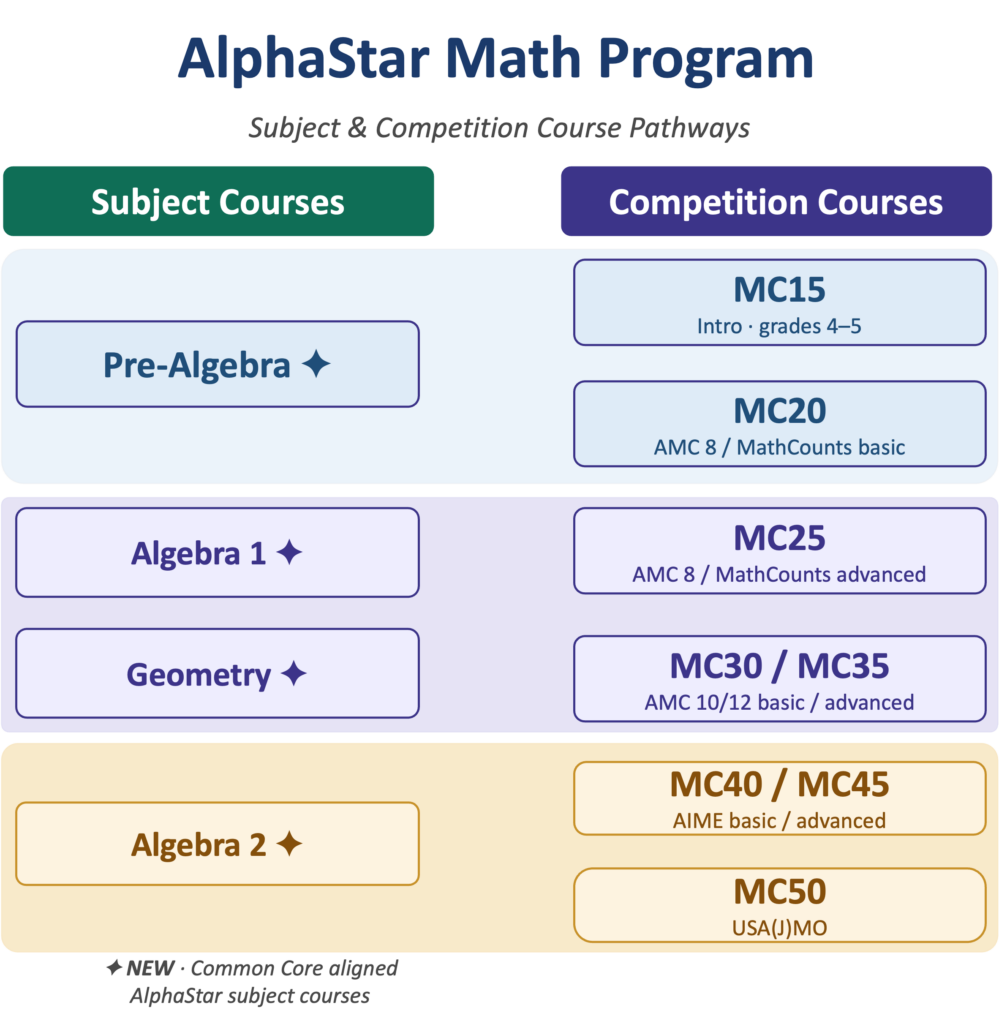
Subject Courses
AlphaStar’s subject courses bring the same faculty expertise and problem-solving culture that define our competition programs to the full school math curriculum, ensuring students build real understanding rather than just learning procedures.
- Common Core Aligned: Fully aligned with Common Core State Standards to support and enhance school mathematics learning.
- High School Credit: AlphaStar is accredited by the Western Association of Schools and Colleges (WASC). Courses may be submitted to your local school district for consideration toward academic credit.
- Proven AlphaStar Methodology: Experience the same rigorous problem-solving approach and instructional excellence that power AlphaStar’s nationally recognized competition programs.
- Deep Mathematical Understanding: Students build true conceptual understanding, not just procedural skills, through carefully designed lessons and challenging problem sets.
Who should take Pre-Algebra?
- Target Audience: Designed for motivated late-elementary and middle school students (roughly grades 5–7) who are ready to move beyond arithmetic and start thinking algebraically. It is ideal for students who want to get a head start before Algebra 1, as well as those who want a deeper, more meaningful foundation in number sense than a typical classroom offers.
- Prerequisites: No prior algebra experience is required, only a solid command of arithmetic with whole numbers, fractions, and decimals, and a curiosity to understand not just how math works, but why.
- Diagnostic Exam and Answers
Who should take Algebra 1?
- Target Audience: Designed for motivated late-elementary and middle school students who are ready to move beyond arithmetic and begin thinking algebraically. It is ideal for students who want to get ahead of their school math sequence, as well as those who want a deeper and more meaningful introduction to algebra than a typical classroom offers.
- Prerequisites: Students should have completed Pre-Algebra through AlphaStar or a standard school course.
- Diagnostic Exam and Answers
Who should take Geometry?
- Target Audience: Designed for students who have completed Algebra 1, either through AlphaStar or a comparable course, and are ready for a thinking-first, proof-centered approach to geometry. It is ideal for students accelerating through the high school math sequence who want to reason through geometric ideas rather than memorize them, with selected honors topics built in.
- Prerequisites: Students should have completed Algebra 1 through AlphaStar or a standard school course.
- Diagnostic Exam and Answers
Who should take Algebra 2?
- Target Audience: Designed for students who have completed Algebra 1, either through AlphaStar or a comparable course, and are ready to go further. It is ideal for students looking to accelerate through the high school math sequence or to strengthen their algebraic foundation before tackling more advanced topics.
- Prerequisites: Students should have completed Algebra 1 through AlphaStar or a standard school course.
- Diagnostic Exam and Answers
Competition Courses
These courses train students for prestigious math competitions such as MATHCOUNTS, the American Mathematics Competitions (AMC) 8/10/12, the American Invitational Mathematics Examination (AIME), and the USA Math Olympiads (USA(J)MO).
Our curriculum is aligned with these competitions. Courses are taught by AlphaStar faculty who have personal participation or coaching experience in national and international math competitions and Olympiads, including the USA Math Olympiad and the International Mathematical Olympiad.
Math Competitions and Course Flow
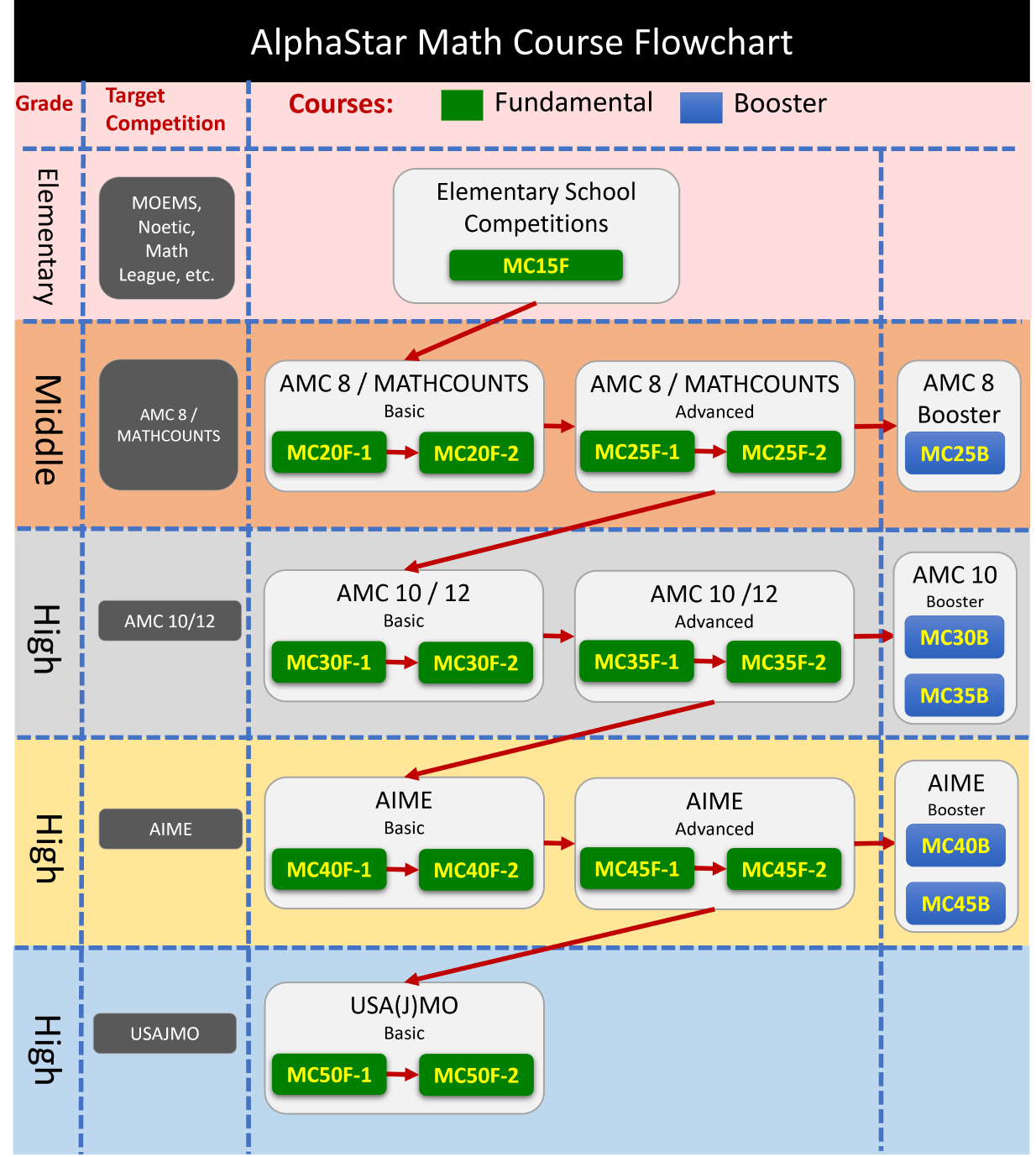
The following chart summarizes the math courses offered at AlphaStar Academy, grouped by competition. Click on a course in the flowchart to see the detailed information about the course.
Why Math Competitions?
- Challenge and Motivation: Math Competitions motivate gifted students through engaging, challenging problems and topics that go beyond the typical math curriculum. Many of them have team rounds, which help build collaboration and team skills and make learning math more fun among peers with similar interests.
- Problem-Solving Skills: Math competitions help students develop and improve problem-solving skills that are valuable in high school, college, and careers as lifelong skills.
- College Applications: Participation and success in math competitions are a great bonus for applications to top universities. For example, Caltech and MIT applications specifically ask for students’ AMC 10/12 and AIME scores.
Why AlphaStar Math Program?
The distinguishing features of the AlphaStar Math Program are summarized below:
- Curriculum/Courses:
Well-established curriculum and course material that has been continually updated since 2008.- Aligned with prestigious math competitions
- More than 6,000 problems and solutions across all levels combined
- Tips, hints, and exam strategies from experts
- Online account with access to all lecture materials and an interactive online forum
- Lecture Materials include Lecture Notes, problems, and solutions for Exams, Lectures, Homework/Practice, and Quizzes.
- Faculty:
Teachers with participation/coaching experience in National and International Math competitions and olympiads. - Environment:
Provides a unique environment and opportunity to be a part of the AlphaStar community of high-achieving and gifted students, parents, and faculty. - Master Classes and Competition Teams:
AlphaStar offers master courses for exceptionally advanced students and field teams for maths competitions organized by prestigious universities. - Achievements:
AlphaStar students and teams participate in many math competitions and get outstanding results, such as MathCounts National qualifiers, AMC 8/10/12 perfect scores, Math Prize for Girls medals, USAJMO/USAMO qualifiers and Winners, USA Mathematical Olympiad Program (MOP) qualifiers, International Math Olympiad medals, and winning teams at Harvard, MIT, Princeton, Berkeley, Stanford, Caltech, and Harvey Mudd math competitions.
Math Curriculum
AlphaStar Math Program offers two types of math courses: Fundamental and Booster courses.
Fundamental Courses
Fundamental courses help students master problem-solving techniques and skills in a level and area of math. There are eight levels with two fundamental offerings in each: Part 1 (Algebra and Counting) and Part 2 (Geometry and Number Theory). Each fundamental course contains lecture notes, example problems, exercise problems (homework), quizzes, and exams.
Booster Courses
Booster courses mainly focus on exam practice and strategies and cover selected topics and skills essential for mastery of math competitions. These courses consist of selected essential topics, problem-solving, practice exams, solutions, and strategy sessions.
Booster courses are offered in five levels: AMC 8/MathCounts Advanced, AMC 10 Basic, AMC 10 Advanced, AIME Basic, and AIME Advanced.
Note: The AMC 10 Basic and Advanced Booster courses focus on the AMC 10 exam and omit topics (Logarithms, Trigonometry, and Complex Numbers) that are needed for the AMC 12 but not for the AMC 10.
Course Types
To see the differences and similarities between fundamental and booster courses, please check the following table.
| Fundamental Courses (*) | Booster Courses | |
|---|---|---|
| Curriculum | All topics | Selected topics |
| Focus | Mastery of the Topics | Exam Strategies |
| Assignments | Yes | No |
| Exams | 3 In-class Exams | 3 Practice Tests (AMC 8) 3 Practice Tests (AMC 10 Booster) 2 Practice Tests (AIME) |
(*) The live versions of these courses are offered at different places:
- Fall+Spring: Weekly sessions for 32 weeks (16 weeks in each semester)
- Summer: Daily sessions on weekdays over 3 weeks
Levels and Diagnostic Exams
Below is a short description of each level, along with a diagnostic exam. You can also take the diagnostic exams online here.
- MC15 (Introduction to Elementary School Math Competitions): For students in grades 4-5 who are good at school math.
- Target Contests: Noetic, Math League, Pi Math Contest, MOEMS, Math Kangaroo
- Who should take: Students who successfully complete the diagnostic exam below.
- MC20 (AMC 8/MathCounts Basic): For middle school students who are familiar with Pre-Algebra topics and want to start training for middle school math competitions
- Target Contests: AMC 8, MathCounts
- Who should take: Students who successfully complete the diagnostic exam below.
- MC25 (AMC 8/MathCounts Advanced): For middle school students who are familiar with Algebra-1 topics and want to master middle school math competitions
- Target Contests: AMC 8, MathCounts, Berkeley mini Math Tournament
- Who should take: Students who successfully complete the diagnostic exam below.
- MC30 (AMC 10/12 Basic): For middle and high school students who are familiar with Algebra-1 topics and want to start training for high school math competitions, AMC 10/12
- Target Contests: AMC 10, AMC 12
- Who should take: Students who successfully complete the diagnostic exam below.
- MC35 (AMC 10/12 Advanced): For middle and high school students who are very comfortable with Algebra-1 topics and want to master high school math competitions, AMC 10/12
- Target Contests: AMC 10/12, Harvard MIT Math Tournament November
- Who should take: Students who can solve, without guessing, between 13 and 18 problems on the diagnostic exam below
- Diagnostic Exam and Answers
(2023 AMC 10A, 25 questions, recommended time is 75 minutes, no calculators)
- Diagnostic Exam and Answers
- MC40 (AIME Basic): For students who are comfortable with the AIME qualification and want to start training for AIME, ARML, and high school competitions organized by prestigious universities.
- Target Contests: AIME, ARML, Harvard MIT Math Tournament, Princeton Math Competition, Caltech Harvey Mudd Math Competition, Stanford Math Tournament, Berkeley Math Tournament
- Who should take: Students who can solve, without guessing, between 2 and 7 problems on the diagnostic exam below
- Diagnostic Exam and Answers
(2024 AIME-I, 15 questions, recommended time is 3 hours, no calculators)
- Diagnostic Exam and Answers
- MC45 (AIME Advanced): For students who want to master AIME, ARML, and high school competitions organized by prestigious universities
- Target Contests: AIME, ARML, Harvard MIT Math Tournament (HMMT), Caltech Harvey Mudd Math Competition (CHMMC), Stanford Math Tournament (SUMO)
- Who should take: Students who can solve, without guessing, between 6 and 12 problems on the diagnostic exam below
- Diagnostic Exam and Answers
(2024 AIME-I, 15 questions, recommended time is 3 hours, no calculators)
- Diagnostic Exam and Answers
- MC50 (USA(J)MO): An introductory proof-writing course. For students who are confident about the USAJMO/USAMO qualification and are willing to work one hour on a single math Olympiad problem.
- Target Contests: USAJMO, USAMO
- Who should take: Students who can work for hours on proof problems and can follow the logical proof solutions, as in the diagnostic exam below
- Diagnostic Exam
(2022 USAJMO Day 1, 3 problems, recommended time is 4.5 hours, no calculators)
- Diagnostic Exam
People Say About This Program
Dr. Jennifer is an excellent teacher. She is one of my favorite teachers and I hope I can continue learning with her. She teaches the material very well and always is ready to answer one of my questions. I wish I have Dr. Jennifer next year too!
Ishaan J
Student
If I have the chance, I would like to take another course in a more advanced level in perhaps a different topic later with this teacher. He was clear and instructive and I really liked him.
Alba G
Student
He detailed everything we needed to know and answered all our questions.
Haramrit B
Student
We are very impressed with AlphaStar camps. They have great qualified teachers and are well organized. My student not only learned rigorous contents but also meet intellectual peers and make a lot of good friends there. We really recommend AlphaStar camps.
C. T.
Parent
Wow. I really loved the course. MC45F1 and 2 are both equally high-quality courses that I learned a lot from every day from the first to the last. This course clarified almost every concept I was struggling with, and was hands-down one of the best math courses I ever attended!
Ethan H
Student
I really appreciated how you kept the class engaged by keeping everybody active and giving everyone chances to present solutions.
Jayden Y
Student
The study material was sufficient and is easy to understand. I also enjoy how the study material is formatted, so it is easy to know what you are doing, and how you are doing.
Aarush M
Student
I would recommend this course to anyone interested in learning the basics of competition math.
Alba
Student
The teacher was very nice and helpful.
Jaden
Student
I highly recommend AlphaStar summer camp for Math. The quality of problems solved during the class and during homework sessions, really help students stretch their thinking. The support staff is very helpful and highly professional. Very highly recommended.
Balaji
I do think that the homework problems were sufficient to understand the content clearly, like for the set of analytic geometry 1 and 2
Chloe Y
Student
The course was fun and the instructor was very helpful. I especially enjoyed the break days because they were relaxing and allowed me to catch up on homework assignments.
Kyle W
Student
Professor Goksel is very enthusiastic about the subject and is always making sure the students are following along with the topic. Makes learning the new topics really fun and engaging.
Haramrit B
Student
Zachary is a great teacher. He explains things well and his work is organized really well! Also, one of his go-to phrases is, \Sweet!\ I think it's a fantastic word so I've adopted it too.
Lucas L
Student
This course was amazing! I learned a lot about all 4 main subject areas of math, and I now have intuition to attack difficult problems. I really recommend this class to anyone who is preparing for the AIME!
Zi-Jie N
Student
The Online classes were great and there were no real problems with the quality of the videos or screen share. The live classes really helped me interact with the teacher and also get to know him better with the activity days.
Anay C
Student
I enjoyed the live courses. The LMS was cool.
Lucas
Student
Isaac Browne is an excellent teacher who explains content very thoroughly and makes learning fun by engaging the students.
Ishan G
Parent
I think that the course overall was great and I enjoyed the classes
Chloe Y
Student
Mr. Spence taught me all the AMC math, I definitely would've failed the AMC 10 without this course but I got a 109.5.
Jason
Student
The instructor, Emre Gul, is one of the best math teachers I have ever learned from, making math enjoyable for all and going above and beyond my expectations as a student
Varin A
Student
The Live Classes were always organized, interactive, and enjoyable; the instructors understood the topics well and easily gave explanations and clarifications as needed. Taking the classes supported my learning and understanding of the concepts presented.
The course was great, with a good variety of problems! I learned a lot.
Julia V
Student
Incredibly helpful course for excelling on the AIME. It introduces very advanced theory useful for competitions like BMT, HMMT, and CHMMC. I learned a lot from this class. Dr. Daniel Deaconu is an incredibly knowledgeable, and dedicated instructor, and I could tell that he genuinely loved teaching the class! My AIME score increased by 75%. :)